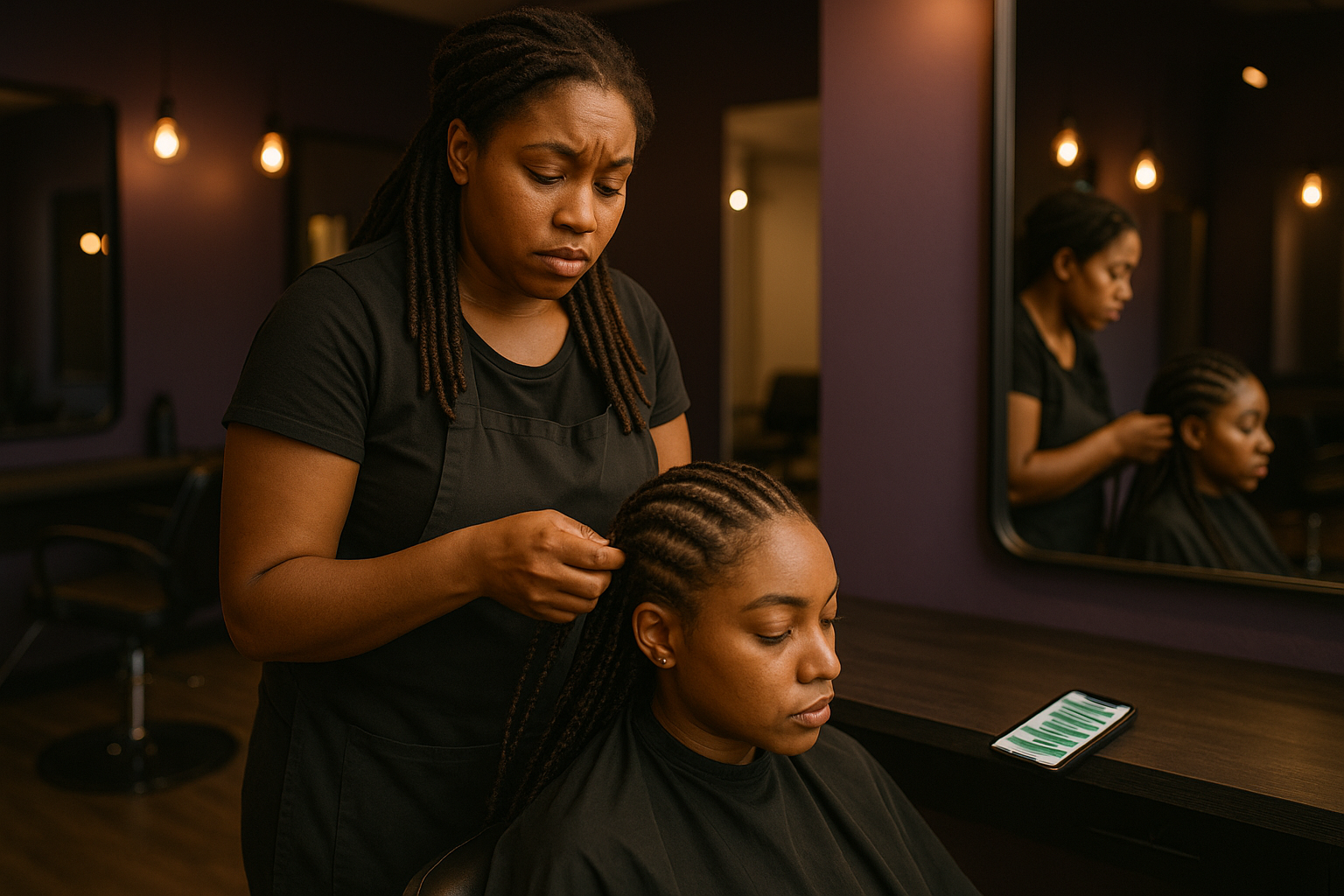
Every braiding salon owner has felt it — that slow Tuesday morning where two clients didn't show, your DMs are full of "what's your availability?" messages you haven't answered yet, and you're rebuilding your schedule in your head while also doing a client's hair. That feeling isn't just stress. It's money leaving your business in real time.
Here's the uncomfortable truth most braiding salon owners aren't ready to hear: manual scheduling isn't a neutral choice. It's an active financial liability — one that compounds quietly every single week. When we talk about braiding salon booking system ROI, most conversations stop at "it's more convenient." That framing is far too small. The real conversation is about how much revenue you are bleeding without one.
The Illusion of "I've Always Done It This Way"
There's a version of the manual-scheduling braider who is genuinely thriving. She's responsive on Instagram, keeps a notes app, and has a loyal clientele. She'll tell you she doesn't need a booking system because she "knows her clients."
Respect the hustle. But here's what she can't see: you cannot measure the revenue you never captured. The client who texted at 11 PM and booked with someone else by morning. The Friday slot that sat empty because no one knew it was open. The repeat client who drifted away because rebooking felt like too much friction.
Manual scheduling doesn't just fail you when things go wrong. It fails you silently when things seem fine.
The Real Cost Breakdown: What Manual Scheduling Actually Costs You
Let's get specific. These aren't hypotheticals — they're patterns that show up across independent natural hair salons every week.
1. No-Shows and Last-Minute Cancellations
Braiding services are long — often 3 to 6 hours per appointment. A single no-show on a box braids slot isn't a minor inconvenience. It can wipe out $150 to $300 of revenue in a single afternoon, with no time to fill that chair.
Without automated reminders and deposit-first booking, you are absorbing that loss entirely. Studies across the service industry consistently show that automated appointment reminders reduce no-shows by 30 to 50 percent. For a salon averaging even two no-shows a week at $200 each, that's $400 in lost revenue — $1,600 a month, $19,200 a year. The math is brutal.
2. The Administrative Time Tax
How long does it take you to manually confirm an appointment? Respond to a DM, check your notes, text back a time, wait for confirmation, re-text if they go quiet — call it 10 to 15 minutes per booking, conservatively. If you're booking 20 clients a week, that's 3 to 5 hours of administrative labor that generates zero revenue.
Now ask yourself: what is your hourly service rate? If you charge $60/hour at the chair, you're trading 3 to 5 hours of your time — potentially $180 to $300 in opportunity cost — every single week just to manage a schedule that a braiding salon booking system would handle automatically.
3. Empty Gaps Between Appointments
Manual scheduling makes it nearly impossible to optimize your calendar in real time. A cancellation happens and that slot stays dark because clients don't know it opened up. There's no waitlist filling the gap automatically. There's no self-booking link you can drop in your Instagram Stories.
A smart booking system with waitlist management turns cancellations into opportunities. Someone on that waitlist gets an automatic notification and grabs the slot. The chair that would have sat empty earns full price instead.
4. The Invisible Referral Leak
Word-of-mouth referrals are the lifeblood of braiding salons. But what happens when a new client gets referred, lands on your Instagram, can't figure out how to book, and gives up? That referral never converted. You'll never know she existed. You'll never see what that single client — across potentially years of loyalty and her own referrals — was worth to your business.
Friction is the enemy of conversion. A public, always-on booking page removes friction entirely. It works while you sleep, while you're doing hair, while you're at your kid's recital.
"But Booking Software Is Too Expensive" — Let's Do That Math
This is the objection I hear most, and it deserves a direct answer.
A braiding salon management system starts at $29 a month. That's $348 a year. Compare that to:
- One recovered no-show deposit per month → $50–$150 recovered
- Three empty gaps filled by waitlist automation per month → $150–$450 recovered
- 5 hours of administrative time redirected to billable services per week → $1,200–$2,400/month in opportunity value
The ROI of a braiding salon booking system doesn't require a spreadsheet to see. It requires honesty about what you're currently losing.
What Makes a Booking System Actually Work for Braiding Salons
Not all booking software is built equally — and this matters enormously for natural hair artists. Generic platforms built for massage therapists or nail salons don't account for:
- Long, variable service durations that require careful calendar blocking
- Client hair type and density that affects service time and product needs
- Style history and preferences that build the stylist-client relationship over time
A platform built specifically for braiding salons — like The BraidFlow — treats these not as workarounds but as core features. Client hair profiles capture hair type, density, previous styles, and preferences automatically. Inventory management tracks your extension supply. Deposit-first booking protects your time before a client even sits down.
This is the difference between a tool that was adapted for braiding salons and one that was built for them.
The Mindset Shift: Stop Thinking of Booking Software as a Cost
The single most important reframe for braiding salon owners considering a booking system is this: stop evaluating it as an expense and start evaluating it as a revenue infrastructure investment.
Your scissors aren't an expense. Your salon chair isn't an expense. These are tools that make revenue generation possible. A braiding salon booking system belongs in that same category. It's the infrastructure your business runs on — or should be running on.
Every week you delay is another week of recoverable revenue that simply doesn't get recovered.
Key Takeaways
- Manual scheduling creates measurable, compounding revenue loss — not just inconvenience
- No-shows alone can cost braiding salons $15,000–$20,000+ annually without deposit protection and automated reminders
- Administrative time spent on manual booking is a direct opportunity cost — hours not spent at the chair
- Waitlist automation turns cancellations into filled slots instead of lost revenue
- Booking friction kills referral conversions you never even see
- The ROI of a braiding salon booking system far exceeds its cost within the first month for most active salons
- Generic booking software doesn't solve braiding-specific problems — purpose-built platforms do
The gap between where your salon is and where it could be often isn't talent, clientele, or location. It's infrastructure. If you're ready to stop leaving money between appointments, start your free trial of The BraidFlow today — built exclusively for natural hair artists who are serious about running a serious business.